
By Francesco Zuppichini, Francesco Cicala
- 11 min Read
TL;DR: The Michael Caloz test is cleaner than Sakinorva because it gives one type instead of three. If it types you
INTP, still read the nearby types likeINTJorISTP. One result is useful, but it is not magic.
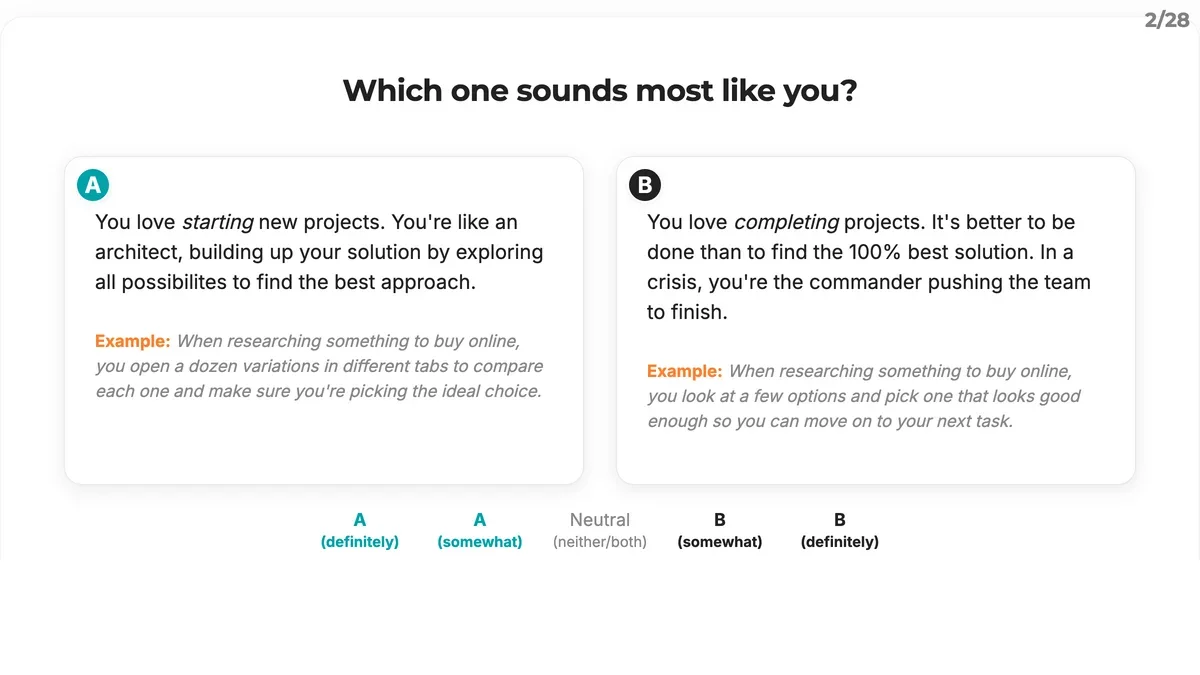
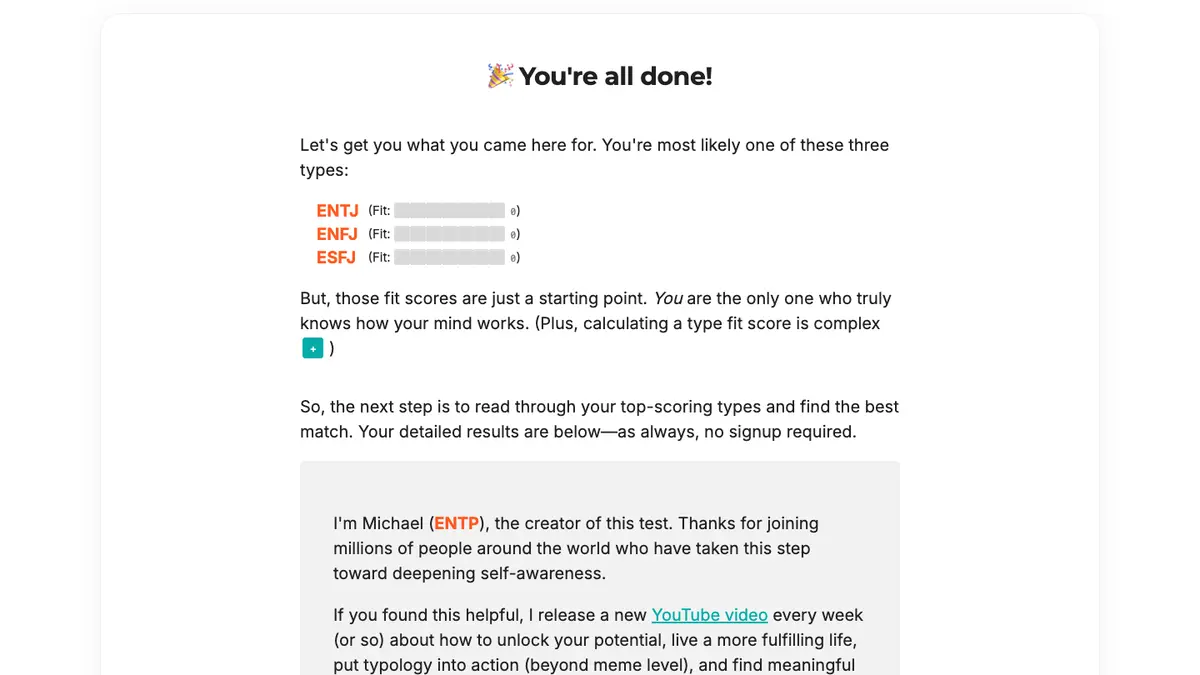
I took the Caloz test on a rainy Tuesday last November, about twenty minutes after Sakinorva spat out three different types for me in a single session. INTP, INTJ, and somehow ISTP, all from the same set of answers depending on which algorithm I squinted at. So I clicked over to Caloz expecting more of the same. Instead the site asked me to pick between two scene descriptions - not statements, scenes - and fifteen minutes later I had one answer. INTP. No alternate calculations. No footnotes. Just the type.
When faced with a complex decision, I prioritize a methodical approach over intuitive leaps.
That's the pitch in one paragraph. Caloz trades Sakinorva's eight-number anxiety for a single verdict. Whether that's a good trade is the whole question.
How the Caloz test actually works
The test throws function pairs at you. Not "I prefer logic to feelings, 1 to 5." Two short scenarios, sometimes a sentence each, and you click the one that feels more like how you'd actually behave. Pick enough times and the thing has read your preferences on four axes:
Nevs.Si- chasing possibilities or trusting what worked beforeNivs.Se- long-view hunches or this-second presenceTevs.Fi- outside logic or inside valuesTivs.Fe- private frameworks or group harmony
Each click touches two functions at once. Lean Ne over Si and both scores shift in opposite directions. Finish the set and you get a four-letter code plus a rough preference strength on each function.
The scenes matter more than the labels
Most function tests ask you to rate abstract statements. "I prefer to think systematically." Sure, who doesn't, depending on the day. Caloz swaps that for contrasting situations - two people handling the same problem differently, two reactions to the same news - and asks which one you'd actually pick. Concrete beats abstract. It's harder to misread a scene than a trait.
How it scores
The math stays inside the pair. It doesn't ask how much Te you have on some absolute scale. It asks whether Te outranks Fi for you, whether Ti outranks Fe, and so on. That constraint kills the Sakinorva paradox where someone scores high on functions that theoretically shouldn't coexist. You can't prefer Te and Fi equally here. The test forces the axis to tilt.
Caloz next to the other tests
vs. 16Personalities
16Personalities measures the four dichotomies straight - I/E, N/S, T/F, J/P - through Likert statements. Fast, clean, one answer. The gripe, known since at least Pittenger's (1993) review in the Journal of Career Planning & Employment, is that forcing a binary on continuous traits hides the 40% of people sitting near the middle of any given scale.
Caloz goes sideways. Instead of the four dichotomies it measures eight function preferences and derives the type. Slower, deeper-looking, same underlying MBTI scaffolding. If 16Personalities is a TSA screening, Caloz is the hand-pat.
vs. Sakinorva
Sakinorva runs multiple calculation engines on your answers and shows all of them. Grant stack, Myers-letter, function count - pick your fighter. For a lot of people the result is three different types and a headache. I know, I got one.
Caloz commits. One method, one type. You lose the buffet of conflicting data but gain something you can actually do something with. If you left Sakinorva wanting fewer numbers, not more, the Sakinorva breakdown we wrote covers why those methods disagree in the first place.
vs. Keys2Cognition
Keys2Cognition is the elder here. Dario Nardi's lab has been poking at cognitive functions since the early 2000s, and Keys2Cognition uses Likert ratings with development-level output per function. You see which of your functions are "unused" vs. "developing" vs. "excellent." Nerdy, granular, a bit of a slog.
Caloz is the new kid. Visual scenes, forced picks, one clean type. Less data per function but way less friction. I'd hand Caloz to a curious friend and Keys2Cognition to someone already deep in the theory.
What Caloz gets right
Forced choice kills the fence-sitter problem. Nobody lands at "3 out of 5" on everything. You commit, the test commits back.
One type, not three. Clear wins for anyone who wants a handle instead of a panel of warring numbers.
The UX is nicer. Scenes over trait statements. Visuals over walls of text. It feels like a product, not a research questionnaire from 1994.
It's fast. Forced-pair items cover more ground per click, so the whole thing ends in 10-15 minutes instead of the half-hour Sakinorva can pull you into.
It also lines up with how Jung and Myers-Briggs actually describe the functions - as opposing pairs on axes, not as eight independents. Measuring them as pairs fits the theory better than measuring them as eight standalone scores.
Where it falls apart
The forced choice flattens real people
Your brain isn't a coin flip. Plenty of people run heavy Ne and heavy Si, or Ti plus serviceable Fe. Pickett and colleagues (2020) flagged exactly this in their Personality and Individual Differences review of type-based assessments - the forced binary is doing work the data doesn't support. Caloz has to push every axis to one side, so the output looks decisive in places where you're genuinely split.
When faced with a complex decision, I prioritize a methodical approach over intuitive leaps.
That's the trade. Clean over true. Take it or leave it.
The theory underneath is still shaky
Every cognitive functions test, Caloz included, stands on the same soft ground. Reynierse (2009) in the Journal of Psychological Type laid out the case that the function-stack model doesn't replicate under empirical testing. A better-designed test measuring a construct that doesn't validate cleanly is still a better-designed test measuring something wobbly. Our MBTI criticism piece digs into that rabbit hole if you want it.
No margins visible
You don't see how close the calls were. Did Te nudge past Fi by a hair, or by a mile? Sakinorva at least shows you the bars. Caloz tucks that information away. Great if you want a verdict, bad if you're the kind of person who wants to know the score, not just who won.
Solo-developer scale
Caloz is one person's project, not a funded research instrument. No published reliability coefficients. No test-retest data I could find. The logic is sound - function pairs, forced choice, single output - but it hasn't gone through the kind of psychometric wringing that, say, the NEO-PI-3 went through in Costa and McCrae (2010).
The times Caloz earns its spot
New to functions? This is the least painful on-ramp. Scenes make sense even if "auxiliary introverted intuition" means nothing to you yet.
Burnt out on Sakinorva? Caloz's single type is a palate cleanser. You'll know which way you lean without arguing with a spreadsheet.
Dipping a toe into MBTI? It's the middle rung. More substance than 16Personalities, less commitment than Keys2Cognition or Sakinorva.
Short on time? Fifteen minutes, done. Faster than most alternatives at this depth.
When I'd steer you elsewhere
Want actual science? No function test meets modern psychometric bars. The Big Five has decades of cross-cultural validation. It's boring next to MBTI flavor, and it's also the one researchers actually use.
Want nuance? If you're the 40% of people who fall between two types, Caloz forces a pick you don't believe. Sakinorva at least lets the ambiguity show.
Want something you can use Monday morning? Knowing you're an INTP doesn't tell you which job to take. For career fit or relationship patterns, tools built for those questions do more work.
Want smarter measurement? Adaptive tests pick the next question based on what you've already answered - same precision, fewer items. SoulTrace runs on Bayesian active learning: each question is chosen to cut the uncertainty on your specific profile the most.
What to do with your result
Read the type description before you read the letters. The four-letter code is shorthand. The behaviors are the thing. If the description feels like a stranger's, the test missed.
Cross-check. Take 16Personalities and Sakinorva too. If all three converge, you've got a real signal. If they don't, you're in the between-types zone, which is most people, and forcing one answer is a kind of lie.
Read your neighbors. Typed INTP? Read INTJ, ISTP, and ENTP. Sometimes the adjacent type fits better and the test pushed you one step sideways because of a single close call.
Don't tattoo the letters on anything. Any one test is a data point. Your own self-observation over the last ten years weighs more than any fifteen-minute click-through.
Past function typing
Cognitive functions represent one bet about personality: define the theory, then measure it. Top-down. The other bet is bottom-up - measure behavior, see what clusters, name the clusters. That's how the Big Five was built, and it's how archetype-based tools work now.
SoulTrace runs the bottom-up version. Five psychological drives measured straight through behavioral preferences. Adaptive questioning that picks the next item based on your previous answers. Twenty-five archetypes that fall out of the data, not out of a theorist's desk. And a probability distribution - how strongly you match each pattern - instead of a binary verdict.
When faced with a complex decision, I prioritize a methodical approach over intuitive leaps.
No stacks to argue about. No forced picks between theoretical opposites. Just how you actually show up, mapped to archetypes that feel like people.
FAQ
Is the Caloz test accurate?
It types people consistently within its own logic. Whether it types them correctly depends on whether the cognitive function theory holds up, and that's still scientifically unsettled.
How long does it take?
Ten to fifteen minutes. Faster than Sakinorva. Slower than 16Personalities.
Is it free?
Yes. No paywalls, no upsells.
Why did I get different types on Caloz vs. 16Personalities?
Different measurement targets. 16Personalities measures the four dichotomies; Caloz measures function preferences and derives the type. Same framework, different operationalizations. Neither is the final word.
Caloz or Sakinorva?
If they agree, go with the agreement. If they disagree, the honest read is you don't fit one type cleanly - which is most of us.
Is it good for beginners?
Yeah, best I've found. Scene-based questions and forced picks make cognitive functions approachable without a Jung primer.
The one thing worth trying instead
Caloz is the cleanest cognitive-functions test out there. Nice design, one answer, low friction. Good product.
If stronger methodology matters, try SoulTrace instead. Twenty-four adaptive questions. Five measured drives. Twenty-five archetypes with probability distributions. No function stacks to litigate - just a direct read on how you think and behave, mapped to patterns you can use.
What Readers Usually Need Next
People searching for Michael Caloz Test: Results, Functions, and Limits often need a quick answer first: what the test is good at, what it misses, and whether it is worth using before they invest time in a result. The safest reading is to treat the tool as a lens, then check whether the explanation matches behavior you can actually observe.
If a result gives you a type but not a reason, compare it with a motivation-based model. Ask what the result predicts about decisions, conflict, stress, and connection. A test earns trust when it helps you make those predictions without flattening your personality into a mascot.
When the search intent is high-volume, a page also needs to say what not to do. Do not treat a ranking, percentage, or viral type description as a diagnosis. Do not use one test result to explain every conflict. Use it to generate better questions, then look for patterns across time.
Other Articles You Might Find Interesting
- Sakinorva test and how to interpret its results - the more complex cognitive functions alternative and what its multiple outputs mean
- Cognitive functions test explained - the theory behind all function-based MBTI assessments
- MBTI alternatives with empirical backing - frameworks that sidestep cognitive function theory entirely
- Best personality tests compared - how different platforms stack up across accuracy, depth, and usability
Stay in the loop
Get notified about new archetypes, features, and insights.