
By Francesco Zuppichini, Francesco Cicala
- 13 min Read
TL;DR: Use Sakinorva for the scores, not the final type. If one method says
INTPand another saysINFJ, don't blindly pick one. Look at your highest function scores first; the type label is just a rough guess.
I took Sakinorva three times last spring. Three different types came back. INTP, then INFJ, then ENTP with low confidence. Same brain, same hour, same answers give or take a few honest recalibrations. If that's happened to you, keep reading. The test isn't broken. It's showing you something about the theory underneath, and most people miss what that something actually is.
Sakinorva is a free cognitive-functions MBTI test. It runs on Jung's eight functions instead of the four dichotomies that sites like 16Personalities lean on. That's the pitch. In practice, you get more data, more interpretive choices, and usually more confusion than you started with.
When faced with a complex decision, I prioritize a methodical approach over intuitive leaps.
What the test actually measures
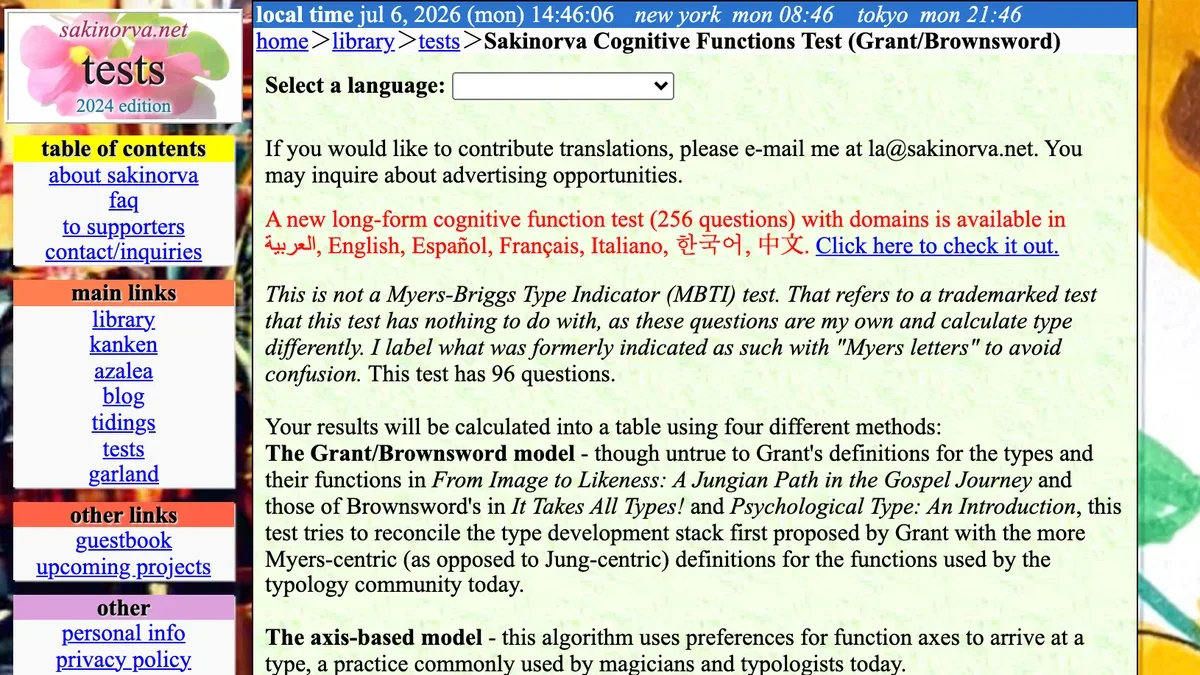
Sakinorva measures your self-reported preference for the eight Jungian cognitive functions, then tries to infer an MBTI type from that pattern. It does not measure intelligence, mental health, or a stable clinical trait. It measures how strongly you endorse items tied to functions like Ne, Ti, Fe, and Si.
The perceiving side covers how you take information in: Ne (pattern-spotting out in the world), Ni (internal, future-angled synthesis), Se (present-moment sensory awareness), and Si (memory and felt-sense comparison to past experience). The judging side covers how you decide: Te (organising the external world by efficiency and logic), Ti (internal categorical precision), Fe (social harmony and group emotion), and Fi (private values and what feels authentic to you).
Classic MBTI theory says each type uses four of those eight, stacked in a specific order. Dominant function is strongest, auxiliary supports it, tertiary is underdeveloped, and the inferior function is the clumsy blind spot. Whether you buy that stack model is where everything gets contentious.
| Result field | What it means | How much to trust it |
|---|---|---|
| Function scores | Your relative score for all eight functions | Most useful part of the test |
| Grant type | A type inferred from the classic stack model | Useful only if the stack fits cleanly |
| Myers type | A type inferred with different weighting | Treat as a second opinion |
| Axis type | A type inferred from paired function axes | Helpful for seeing why results split |
How it spits out three types
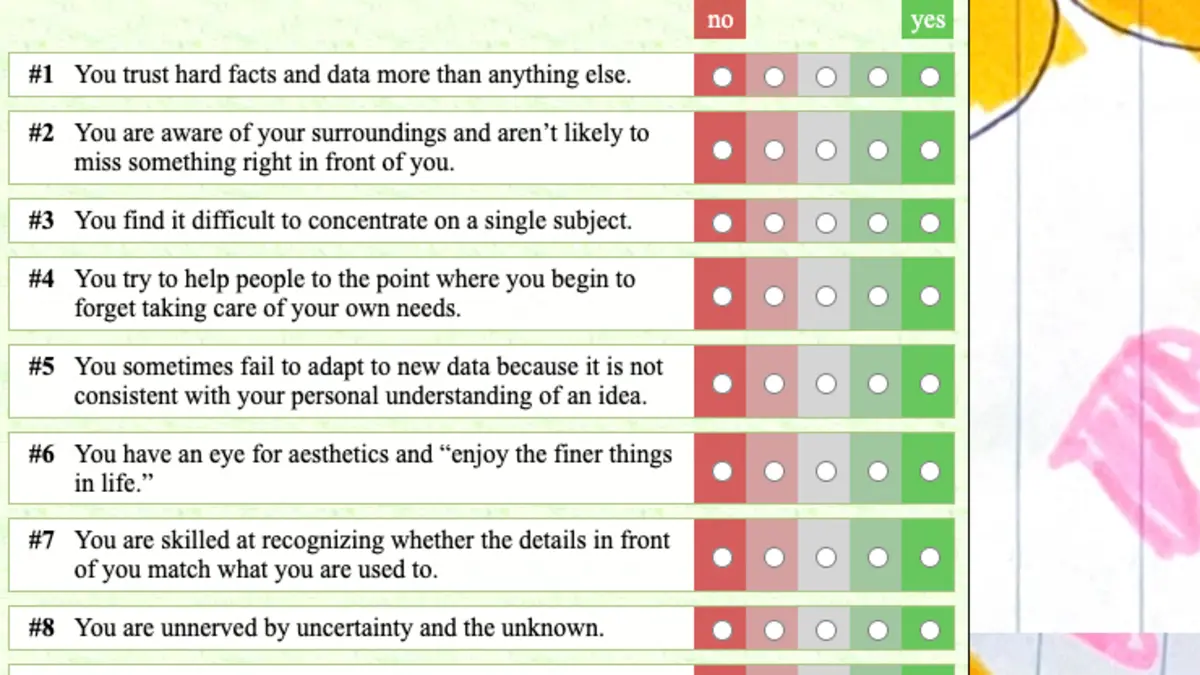
Sakinorva gives three types because it runs the same function scores through three different typing models. When those models agree, your result is relatively clean. When they disagree, the test is exposing a theory conflict rather than making a simple mistake.
The test asks questions designed to isolate each function. You answer, it scores all eight, and then it runs your scores through three calculators.
There's the Grant method, named after Harold Grant and based on the traditional function stack, which locks in your top four functions in the canonical order. There's the axis-based method, which looks at pairs like Ne-Si or Te-Fi and figures out which axis you favour. And there's Myers' method, which weights things a little differently and sometimes disagrees with both.
You often get two or three different type suggestions. That's by design. The tool is showing you the disagreement between models, not hiding it behind a single clean answer.
Why the three methods disagree
The calculators rest on different theoretical bets about how functions stack. Grant assumes a strict alternation of attitudes (if your dominant is introverted, your auxiliary is extraverted, and so on). The axis model assumes that functions come in pairs you can't unbundle. Myers' method doesn't fully commit to either.
Nobody in the MBTI community agrees which bet is right. Sakinorva didn't invent this fight. The whole cognitive-functions field has been arguing with itself since the 1980s, and any tool built on those ideas inherits the argument.
Sakinorva vs. 16Personalities
Sakinorva and 16Personalities answer different questions. 16Personalities asks which four-letter style you resemble. Sakinorva asks which cognitive functions you seem to use, then tries to reverse-engineer the four-letter type from there.
Short version: 16Personalities asks you directly whether you're more introverted or extraverted, more N or S, more T or F, more J or P. Four scales, four answers, stitched together into a type.
Sakinorva skips the dichotomies and asks you about functions instead. Do you tend to brainstorm outwards (Ne) or sit with one internal vision (Ni)? Do you reach for efficient systems (Te) or for categorical precision (Ti)? It then infers your four-letter type from the function pattern.
The Sakinorva approach sounds more sophisticated, and in theory it is. An INFJ and an INFP look pretty similar on dichotomies but their function stacks are totally different: Ni-Fe-Ti-Se versus Fi-Ne-Si-Te. If the functions are real, measuring them directly should be the better move.
Big if. The theory beneath those functions is where the whole thing wobbles.
The cognitive functions problem
The cognitive functions problem is simple: the model is elegant, but the evidence is weak. Sakinorva can be a thoughtful test and still inherit the same validation problem as the theory underneath it.
Jung laid out psychological types in 1921. Myers and Briggs adapted the idea in the 1940s and 50s. The theory is internally tidy. It's also, by most modern standards, poorly validated.
A few specific problems. Measuring a function is genuinely hard because there's no agreed-upon way to operationalise "extraverted intuition," so two tests that both claim to measure Ne will often disagree about what Ne looks like in a sentence. Validation studies have been weak or inconsistent for decades; the predicted stack patterns don't show up cleanly in factor analyses. Even inside the MBTI community, experts argue about whether a given behaviour is Ne or Se. And the whole setup treats binaries where spectrums live. You're meant to have a single dominant thinking function, but most real people mix Te and Ti depending on context.
Sakinorva tries to soften this by showing you all eight scores. Fair. But that creates a different problem. How do you read eight numbers that don't cleanly map to one type? For a broader look at MBTI alternatives with stronger empirical backing, there are frameworks that sidestep this whole mess.
Reading your Sakinorva results
Read Sakinorva results in this order: function scores first, agreement between methods second, four-letter type last. The common mistake is treating the final type as the answer and ignoring the score pattern that produced it.
When faced with a complex decision, I prioritize a methodical approach over intuitive leaps.
When you finish, you see raw scores for all eight functions, a handful of suggested types from the different methods, and often a disagreement between them.
If all three methods agree, congrats. Your function pattern lines up with that type's theoretical template and the interpretation is about as solid as cognitive-functions interpretation gets.
If they disagree, you're in the grey zone. That's not a defect. It's the theory telling on itself. A lot of humans just don't sit cleanly on one function stack.
Use this quick read:
- Start with your top two functions and ask whether they describe your actual behaviour, not your ideal self.
- Check whether the suggested type uses those functions in a plausible order.
- Treat a one-point difference between functions as noise, not destiny.
- If Grant, Myers, and axis results split, write down the shared pattern instead of forcing one label.
What a high function score means
A high Ne score means you endorsed items associated with Ne. That's all it strictly means. Maybe you actually use Ne heavily. Maybe you wish you did. Or the questions happened to ring true for unrelated reasons, or it's just noise. Without something external to check against, you can't tell which is driving the number.
What conflicting types mean
Most likely your function scores don't fit any single theoretical stack, the three calculators weight things differently enough to break a tie three different ways, and human personality simply doesn't carve up into neat function stacks the way the theory wants it to. Conflicting results aren't a bug. They're the model hitting its limit.
Should you take it?
If you already find cognitive-functions theory interesting, if you've gotten inconsistent MBTI results elsewhere and want a deeper look, or if you enjoy detailed personality analysis for its own sake, go take it. It's free and it won't waste your afternoon.
Skip it if you want scientifically validated measurement, if conflicting suggestions make you frustrated rather than curious, or if you need something actionable to work with rather than something to chew on.
Sakinorva goes deeper into MBTI theory than most free tests bother to. But depth inside an unvalidated framework doesn't make the framework valid. If you're shopping around, check how Truity's multi-framework approach and the HIGH5 strengths-based model frame the same question differently, or which IDRlabs quizzes are worth taking.
What I'd reach for instead
The Big Five (OCEAN) is the most validated personality model in psychology. Five dimensions, Openness, Conscientiousness, Extraversion, Agreeableness, and Neuroticism, have decades of replication behind them. Unlike cognitive functions, OCEAN dimensions measure consistently across tests, replicate across cultures, and predict real-world outcomes like job performance and relationship satisfaction. The model was built from statistics up, not theory down.
For something that preserves MBTI's pattern-recognition feel without the theory debt, the SoulTrace assessment maps a five-color psychological model to 25 archetypes and gives you a probability distribution rather than a verdict. Twenty-four adaptive questions, Bayesian selection, no function stacks to wrestle with.
And honestly? If you want to know your traits, ask directly. "How organised are you, 1 to 5?" beats "do you prefer Te or Ti as your dominant judging function?" every time.
What Sakinorva does well
Use Sakinorva when you want to inspect the function pattern instead of getting a tidy MBTI label. The best part is not the final type. The best part is the disagreement, because it shows where your answers fit the theory and where they don't.
It's worth giving the test its due. Showing eight scores instead of forcing a four-letter verdict is honest because it admits personality isn't 16 neat boxes. Offering three calculation methods is also honest, because it admits the theory doesn't give one definitive answer. False precision would be worse.
For people who find Jungian typology genuinely interesting, Sakinorva is about the best free tool out there. The measurement itself is thoughtfully designed. The limitations are in the theory it's measuring, not the implementation.
Its strongest use cases are narrow but real:
- Comparing your function scores against the type you already suspect.
- Seeing why two MBTI tests keep giving you different letters.
- Learning the function vocabulary without paying for a typology course.
- Spotting when a four-letter result is too confident for the underlying scores.
If you've already taken it
Don't over-index on the four-letter code. The letters matter less than the pattern of which functions actually ring true for you. If your Ne score is consistently high across tests and across life, that's useful information no matter which type Sakinorva settled on.
Any single test is one data point. Don't let it overrule what you already know about yourself. And if Sakinorva left you confused, that confusion is data too. Maybe the framework doesn't fit you cleanly, and that's fine.
When faced with a complex decision, I prioritize a methodical approach over intuitive leaps.
Another lens on personality
Cognitive functions are one way of cutting up personality. Others exist.
SoulTrace works from a five-color model:
- White: structure, responsibility, fairness
- Blue: understanding, precision, mastery
- Black: agency, achievement, strategy
- Red: intensity, expression, authenticity
- Green: connection, growth, belonging
Twenty-five archetypes emerge from combinations of those colors. The colors are defined behaviourally and measured directly, not inferred from a theoretical stack. Each question is chosen to maximise information gain based on your previous answers, so 24 adaptive questions get you where a fixed 100-item test would.
FAQ
Is Sakinorva accurate?
For cognitive-functions theory, Sakinorva is accurate enough to explore patterns, but not accurate enough to treat as a validated psychological assessment. It can show a useful pattern in your answers. It cannot prove your true type.
Why different types on Sakinorva vs. 16Personalities?
Different operationalisations. 16Personalities reads dichotomies off direct self-report. Sakinorva reads functions off indirect items and infers type. Neither is definitively correct; they're different maps of loosely defined territory.
Which Sakinorva result should I trust?
Trust the shared pattern more than any single label. If all three methods agree, that type is the cleanest read. If they don't, the honest read is that the theory doesn't fit you cleanly, and you're somewhere between types.
Is Sakinorva better than 16Personalities?
Compared with 16Personalities, Sakinorva is more detailed but not automatically more reliable. It gives more nuance, more ambiguity, and more room for interpretation. 16Personalities gives cleaner answers at the cost of oversimplifying.
Are cognitive functions scientifically valid?
Poorly supported. The theory is internally coherent but hasn't held up under rigorous testing. Psychologically interesting, yes. Scientifically established, no.
Try another path
Sakinorva offers one route into self-understanding. If cognitive functions fascinate you, it's absolutely worth a couple of sessions.
For measurement with stronger science behind it, take the SoulTrace assessment. Adaptive Bayesian method. Archetype matching. Probability distributions instead of false certainty. Twenty-four questions, no function stacks required.
What Readers Usually Need Next
People searching for Sakinorva Test Results: Complete Guide [2026] often need a quick answer first: what the test is good at, what it misses, and whether it is worth using before they invest time in a result. The safest reading is to treat the tool as a lens, then check whether the explanation matches behavior you can actually observe.
If a result gives you a type but not a reason, compare it with a motivation-based model. Ask what the result predicts about decisions, conflict, stress, and connection. A test earns trust when it helps you make those predictions without flattening your personality into a mascot.
When the search intent is high-volume, a page also needs to say what not to do. Do not treat a ranking, percentage, or viral type description as a diagnosis. Do not use one test result to explain every conflict. Use it to generate better questions, then look for patterns across time.
Other Articles You Might Find Interesting
- MBTI alternatives that deliver stronger scientific validity - frameworks that solve the problems Sakinorva inherits from Jungian theory
- Comparing the best personality tests available today - how Sakinorva stacks up against validated alternatives
- Truity personality test platform review - another multi-framework platform with different strengths and limitations
- What personality test accuracy actually requires - the science of reliability and validity that cognitive functions struggle to meet
Stay in the loop
Get notified about new archetypes, features, and insights.