By Francesco Zuppichini, Francesco Cicala
- 8 min Read
You've probably noticed the pattern. Different people, same dynamic. Maybe you keep choosing partners who need rescuing. Or you lose interest the moment someone is genuinely available. Or every relationship hits the same wall around month four, and you can't figure out what keeps going wrong.
That's not bad luck. That's personality.
Dating apps match you based on photos, proximity, and whatever curated version of yourself you put in a bio. None of that touches the psychological drives that actually determine whether two people can build something lasting. A personality test won't find you a partner—but it'll show you why you keep finding the same type of partner, and whether that pattern is working for you.
When faced with a complex decision, I prioritize a methodical approach over intuitive leaps.
What a Personality Test Actually Reveals About Your Dating Life
Forget "are you an introvert or extrovert?" That binary tells you almost nothing about how you'll behave in a relationship. The useful questions are deeper:
- What do you need from a partner to feel secure?
- What triggers your defensive reactions?
- Do you move toward people under stress, or away from them?
- Are you attracted to similarity or to what you lack?
Your answers to these questions stem from your core psychological drives—stable patterns that persist across relationships, jobs, friendships, and every other domain where you interact with other humans.
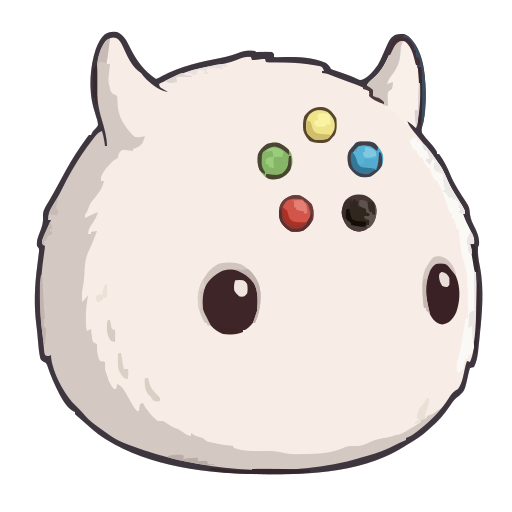
The 5-color model maps five of these drives. Where you fall across them predicts your dating patterns with uncomfortable accuracy.
Your Drive, Your Dating Pattern
If you run high on Structure (White): You date deliberately. Probably have criteria. Maybe a mental checklist, maybe an actual one. You value reliability in partners and get frustrated by flakiness. First dates feel like interviews because, for you, they kind of are.
The trap: You screen for compatibility so aggressively that you filter out anyone who might challenge you. The person who's "perfect on paper" might bore you within six months because you optimized for safety, not spark.
If you run high on Understanding (Blue): You're drawn to depth. Small talk at a bar is torture. You want to know what someone thinks about at 2am, what shaped their worldview, what they're genuinely curious about. When you find intellectual chemistry, it hits you harder than physical attraction.
The trap: You might mistake understanding someone for connecting with them. You can analyze a partner's emotional landscape in clinical detail while remaining completely emotionally unavailable yourself. Partners of Blue-dominant people sometimes feel studied rather than loved.
If you run high on Agency (Black): You're attracted to competence. Someone who has their shit together, knows what they want, and isn't waiting for permission to go get it. You don't need a partner—you choose one, and you expect them to add real value to your already-functional life.
The trap: Relationships require vulnerability, and vulnerability feels like weakness to you. You might keep partners at arm's length, presenting your best self without ever letting them see the mess behind it. The emotionally unavailable pattern frequently maps to high-Agency individuals who confuse self-sufficiency with emotional health.
If you run high on Intensity (Red): Dating is an emotional experience for you, sometimes overwhelmingly so. You fall fast, love hard, and can tell within minutes whether there's chemistry. Passion isn't negotiable—you'd rather be alone than in a relationship that feels lukewarm.
The trap: You might confuse intensity with compatibility. The person who makes your heart race might be a terrible long-term partner. High-intensity attraction often correlates with anxious attachment patterns—the thrill you feel might be anxiety dressed up as chemistry. Worth checking your attachment style if this sounds familiar.
If you run high on Connection (Green): You're the partner everyone wants and nobody appreciates enough. You attune to people's emotional states automatically, you remember the small things, and you create emotional safety wherever you go.
The trap: You attract people who take more than they give. Your natural warmth reads as "I'll take care of you," which magnetizes partners who need caretaking rather than partners who can stand on their own. The codependency pattern thrives in Green-dominant individuals who mistake self-sacrifice for love.
Patterns You Don't See Until Someone Points Them Out
A personality assessment for dating isn't about finding your "type." It's about surfacing the unconscious patterns driving your choices.
Three of the most common:
The Complementarity Trap. You're drawn to people who have what you lack. A structured, cautious person falls for a spontaneous, chaotic one. An emotionally reserved person falls for someone who wears their heart on their sleeve. The initial attraction is magnetic—they complete you! Then six months in, the exact traits that attracted you become the ones that drive you insane. Their spontaneity is now irresponsibility. Their emotional openness is now drama.
When faced with a complex decision, I prioritize a methodical approach over intuitive leaps.
This isn't random. Your psychological drives create gaps, and you unconsciously seek partners to fill them. Understanding your archetype helps you see which gaps you're trying to fill—and whether you'd be better served filling them yourself.
The Repetition Pattern. Different face, same dynamic. You keep ending up with emotionally distant partners, or controlling ones, or partners who need saving. The names change; the script doesn't.
This happens because your drives create a filter. You literally don't register people who fall outside your pattern. The kind, stable person at the party? You didn't notice them because your Red drive was scanning for intensity. The interesting, quiet person in the corner? Invisible to your Green drive, which was busy reading the room's emotional temperature.
The Stress Reveal. Early dating is a performance. Everyone is charming at dinner. The real test is what happens under stress—disagreements, disappointments, unmet expectations. Under pressure, people revert to their dominant drive's shadow side. White becomes rigid and judgmental. Blue becomes cold and dismissive. Black becomes controlling. Red becomes volatile. Green becomes passive-aggressive.
Knowing your stress pattern—and recognizing a potential partner's—saves you from being blindsided six months in when real life intrudes on the honeymoon phase.
Using Personality Insight While Actually Dating
This isn't about categorizing dates or turning every coffee meeting into a clinical assessment. It's about asking better questions and noticing what matters.
Before the date: Know your own drives. Seriously. If you haven't taken a personality assessment recently, do it before your next swipe session. Not to find your "ideal match" but to understand what you're bringing to the table—including the parts you'd rather not advertise.
During the date: Notice energy, not just conversation. Does this person's presence energize you or drain you? Not whether they're interesting or attractive—those are surface signals. Whether being near them adds something to your baseline state or subtracts from it. That's a drive-level signal that predicts long-term compatibility far better than shared taste in movies.
After the date: Check your reaction against your pattern. If you're buzzing with excitement after a first date, ask yourself: is this genuine connection, or is this my pattern repeating? Red-dominant individuals in particular should learn to distinguish between "I'm excited because this person is genuinely compatible" and "I'm excited because this person triggered my intensity drive."
When it gets serious: Have the personality conversation. Not "what's your type" small talk—an actual discussion about psychological drives. Share your assessment results. Ask about their patterns in past relationships. The willingness to have this conversation is itself a compatibility signal. People who deflect or dismiss self-knowledge tend to repeat their patterns indefinitely.
When faced with a complex decision, I prioritize a methodical approach over intuitive leaps.
What Dating Apps Get Wrong
Matching algorithms optimize for engagement, not compatibility. They learn what makes you swipe right—which is a measure of attraction, not a measure of relationship potential. Attraction and compatibility overlap, but not nearly as much as the apps want you to believe.
A personality-driven approach flips the script. Instead of "who am I attracted to?" it asks "what do I actually need in a partner for a relationship to function?" Those are different questions with different answers.
You might be attracted to intensity but need stability. You might swipe on adventurous types but thrive with homebodies. Your drives create both your attractions and your needs—and those often point in opposite directions. Understanding the difference between what pulls you in and what sustains you is the gap most daters never close.
The Uncomfortable Truth
No personality test will prevent heartbreak. People are complicated, circumstances are unpredictable, and even well-matched partners sometimes grow apart.
What a personality test does is shrink the gap between who you think you are in relationships and who you actually are. Most dating problems aren't about finding the right person—they're about not understanding the person doing the searching.
If you keep hitting the same walls, the wall isn't the problem. Your approach to the wall is.
Take the assessment. See what it surfaces about your drives. Then take that knowledge into your next conversation, your next date, your next relationship. Not as a script, but as awareness. Awareness doesn't guarantee anything—but dating without it is just rolling dice with better lighting.
Other Articles You Might Find Interesting
- Personality Test for Couples - Already in a relationship? Here's how to use personality insight together
- Am I Anxiously Attached? - If your dating pattern involves chasing unavailable people, start here
- Which Personality Type Falls in Love Hardest? - Some types fall faster and harder than others—find out why
- Am I Avoidant? - The flip side of anxious attachment, and equally common in dating struggles
Stay in the loop
Get notified about new archetypes, features, and insights.