
By Francesco Zuppichini, Francesco Cicala
- 10 min Read
TL;DR: No MBTI type is automatically smarter than the others.
INTPandINTJoften look smart because they enjoy abstract thinking, but intelligence depends on the task. AnESFJnurse reading a room under pressure is using intelligence too.
Let's address this directly: people search "MBTI types ranked by intelligence" hoping for a list that validates either their own type or their suspicions about others.
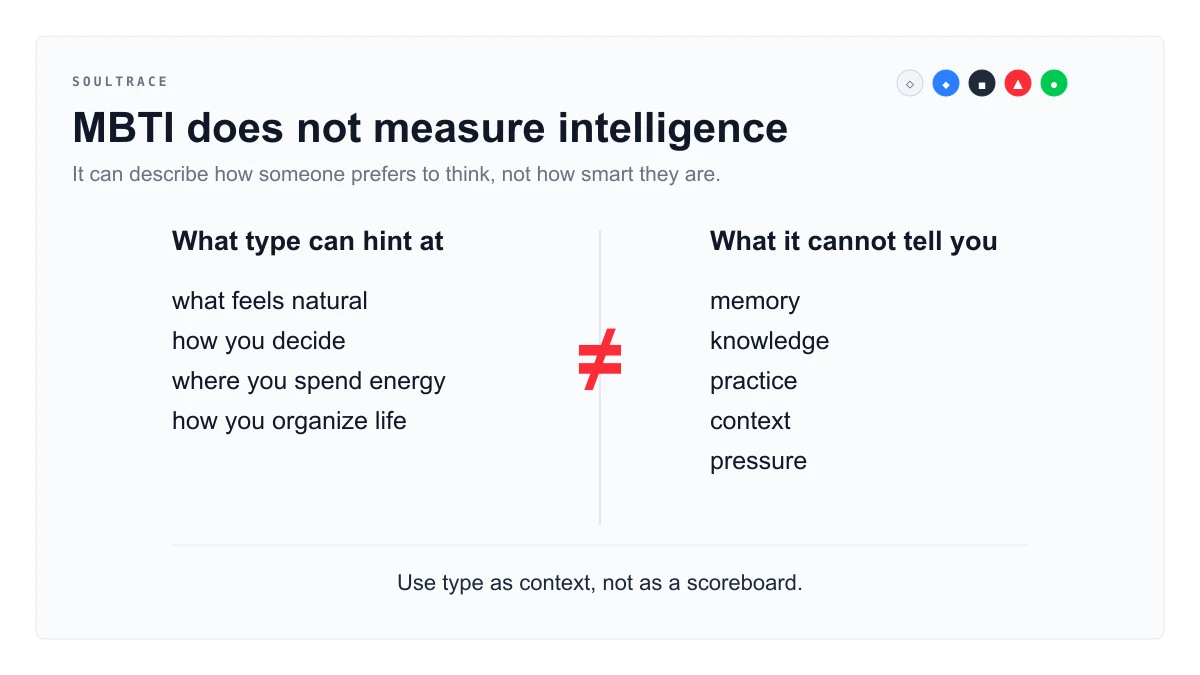
Here's the reality: MBTI doesn't measure intelligence. It measures cognitive preferences - how you prefer to process information, not how well you process it. An INTP and an ESFJ can have identical IQs while thinking in completely different ways.
That said, the question reveals something worth exploring: how different types apply their intelligence, why certain types dominate particular domains, and why our culture conflates one kind of intelligence with intelligence itself.
When faced with a complex decision, I prioritize a methodical approach over intuitive leaps.
Why This Question Is Fundamentally Flawed
The search for "most intelligent MBTI type" assumes:
-
Intelligence is one thing. It's not. Logical-mathematical, verbal, spatial, interpersonal, intrapersonal, musical, bodily-kinesthetic, and naturalistic intelligences all exist. IQ tests measure only a subset.
-
MBTI measures ability. It doesn't. MBTI measures preferences. Preferring intuition over sensing doesn't make your intuition better - it just means you use it more.
-
Types differ in raw cognitive capacity. No evidence supports this. Within every type, you find geniuses and average minds.
-
"Intelligence" as commonly defined is neutral. It's not. What we call "intelligence" in everyday language usually means "thinks like an academic" or "good at the kind of abstract reasoning that correlates with IQ tests."
What Research Actually Shows
IQ and MBTI Correlations
Limited research exists, and what exists has significant methodological problems. However, some weak patterns emerge:
Introversion shows slight positive correlation with IQ. Introverts may score marginally higher on standardized tests - but this could reflect testing conditions (quiet, individual, written) that favor introverted work styles, not actual intelligence differences.
Intuition shows slight positive correlation with IQ. N types tend to score higher on abstract reasoning tests - but these tests specifically measure abstract reasoning, which N types practice more. Sensing types excel in practical intelligence that IQ tests don't capture.
Thinking shows no meaningful correlation with IQ in well-designed studies. Despite stereotypes, T types aren't smarter than F types. They just prefer logical frameworks over emotional ones.
Perceiving shows slight positive correlation with IQ in some studies. This may reflect P types' comfort with open-ended problems and J types' preference for closure.
Effect sizes are small. Even where correlations exist, they explain tiny amounts of variance. Individual differences within types dwarf differences between types.
The INTP/INTJ Myth
INTPs and INTJs frequently top "most intelligent type" lists. Let's examine why this is misleading:
Why INTPs/INTJs appear intelligent:
- They enjoy abstract thinking and discuss ideas openly
- They often pursue intellectual hobbies
- They fit the cultural stereotype of "smart person"
- They're overrepresented in STEM and academia
- They often identify strongly as "intellectual"
What this ignores:
- They may be less intelligent in interpersonal or practical domains
- Academic overrepresentation reflects preference, not superior ability
- Enjoying intellectual activity doesn't mean being better at it
- Many brilliant people avoid intellectual self-identification
An ESFJ nurse reading a patient's nonverbal cues and navigating a family's emotional dynamics during a health crisis is demonstrating intelligence - just not the kind that scores well on IQ tests or gets discussed on personality forums.
Different Types, Different Intelligences
Rather than ranking types, let's examine how different cognitive functions excel in different domains.
Introverted Thinking (Ti): INTP, ISTP, ENTP, ESTP
Ti builds internal logical systems and excels at:
- Analyzing how things work
- Finding inconsistencies in arguments
- Breaking complex problems into components
- Understanding deep principles
Analytical domain: Systems analysis, troubleshooting, theoretical research, programming
Extraverted Thinking (Te): ENTJ, ESTJ, INTJ, ISTJ
Te organizes external systems and excels at:
- Implementing efficient processes
- Measuring and optimizing outcomes
- Making decisions under pressure
- Translating strategy into action
Operational domain: Management, operations, strategic planning, business
Introverted Feeling (Fi): INFP, ISFP, ENFP, ESFP
Fi navigates personal values and excels at:
- Understanding individual emotional experience
- Maintaining authentic self-knowledge
- Recognizing ethical nuance
- Creating emotionally resonant art
Humanistic domain: Creative arts, counseling, ethics, advocacy
Extraverted Feeling (Fe): ENFJ, ESFJ, INFJ, ISFJ
Fe reads social dynamics and excels at:
- Understanding group emotions and needs
- Building consensus and cooperation
- Teaching and mentoring
- Creating harmonious environments
Interpersonal domain: Leadership, diplomacy, education, healthcare
Introverted Intuition (Ni): INTJ, INFJ, ENTJ, ENFJ
Ni synthesizes patterns into insights and excels at:
- Long-term strategic vision
- Predicting consequences
- Understanding symbolic meaning
- Grasping complex implications
Strategic domain: Strategy, forecasting, theoretical work, creative direction
When faced with a complex decision, I prioritize a methodical approach over intuitive leaps.
Extraverted Intuition (Ne): ENTP, ENFP, INTP, INFP
Ne generates possibilities and excels at:
- Brainstorming and ideation
- Seeing connections between disparate concepts
- Adapting to novel situations
- Asking "what if?"
Inventive domain: Innovation, entrepreneurship, creative problem-solving, research
Introverted Sensing (Si): ISTJ, ISFJ, ESTJ, ESFJ
Si maintains detailed experiential memory and excels at:
- Remembering specific details and procedures
- Recognizing deviations from norms
- Building reliable processes
- Learning from past experience
Reliability domain: Quality assurance, administration, healthcare, finance
Extraverted Sensing (Se): ESTP, ESFP, ISTP, ISFP
Se reads and responds to immediate reality and excels at:
- Reacting quickly to changing situations
- Noticing environmental details others miss
- Physical coordination and timing
- Aesthetic awareness
Tactical domain: Emergency response, athletics, performing arts, tactical execution
Why INTx Types Dominate "Intelligence" Discussions
There's a reason INTPs and INTJs constantly appear at the top of intelligence rankings - and it's not because they're actually smarter.
Cultural bias toward abstract reasoning
Western education and professional selection heavily emphasize the kind of thinking that INTx types do naturally: abstract, theoretical, systems-based. This creates a self-reinforcing cycle:
- Tests measure abstract reasoning
- INTx types score well and enter academia
- Academics design more tests emphasizing abstract reasoning
- INTx types conclude they're the smartest types
- Repeat
Self-reporting and forums
Who discusses MBTI online? Disproportionately: introverted intuitives. They're interested in theoretical frameworks and have the verbal skills to dominate text-based discussions. When they discuss which types are "smartest," they often conclude - surprise - that their own type is smartest.
Visible vs. invisible intelligence
INTx intelligence is visible: publications, credentials, theoretical debates, intellectual hobbies. ESTx intelligence is often invisible: keeping complex operations running, fixing things, managing real-world logistics. We notice what gets displayed.
Successful People Across All Types
If MBTI predicted intelligence, certain types would dominate achievement. They don't.
Scientists and researchers: INTx types are overrepresented, but major contributions come from all types. Barbara McClintock (INTP), Marie Curie (INTJ), but also Jane Goodall (INFJ) and Neil deGrasse Tyson (ENFP).
Business leaders: ENTx types are overrepresented in corporate leadership, but successful entrepreneurs and executives come from all types. Bill Gates (INTJ), Oprah Winfrey (ENFJ), Warren Buffett (ISTJ).
Artists and creators: NFx types are overrepresented in creative fields, but innovation happens everywhere. Picasso, Shakespeare, Beethoven - we can't type them reliably, but creative genius clearly spans all preferences.
Athletes and performers: SFP and STP types dominate fields requiring physical intelligence - sports, dance, surgery. This is intelligence, just not the kind measured by IQ tests.
What Actually Predicts Success
If you're interested in developing your capabilities, focus on these factors that actually matter:
Conscientiousness: The Big Five trait most strongly correlated with achievement across domains. Showing up, doing the work, following through.
Deliberate practice: Focused, effortful work on specific weaknesses. 10,000 hours in your domain, not just 10,000 hours of presence.
Growth mindset: Believing intelligence can be developed predicts better outcomes than believing it's fixed.
Domain matching: Playing to your cognitive strengths while developing necessary weaknesses. An ESTP who becomes an emergency room doctor leverages their natural abilities differently than one who forces themselves into theoretical physics.
When faced with a complex decision, I prioritize a methodical approach over intuitive leaps.
Emotional intelligence: Understanding and managing your own and others' emotions predicts success across most domains, often better than IQ.
The Uncomfortable Truth
There is no "smartest MBTI type." There are types that:
- Excel at the narrow band of cognition that IQ tests measure
- Fit the cultural stereotype of "intelligent person"
- Enjoy discussing intelligence and therefore conclude they have it
- Are overrepresented in domains our society happens to respect currently
An ISFJ who masterfully manages a complex household, coordinates a community organization, and provides emotional support that holds a family together is demonstrating tremendous intelligence - just not the kind that gets you called "smart" in casual conversation.
The search for the "most intelligent type" reveals more about what we culturally value than about actual cognitive differences between types.
Conclusion
MBTI types cannot be ranked by intelligence because:
- Intelligence isn't one thing
- MBTI measures preference, not ability
- Different types excel in different cognitive domains
- Individual variation within types dwarfs variation between types
If you came here hoping to confirm that your type is the smartest, or that another type is intellectually inferior - that tells you something about your own insecurities, not about actual intelligence differences.
Every type contains brilliant minds and average minds. Your type indicates how you prefer to think, not how well you think. What you do with your cognitive preferences - through effort, practice, and growth - matters far more than the preferences themselves.
Want to understand your own cognitive patterns at a deeper level? Take our comprehensive personality test to discover your psychological profile - how you think, decide, and engage with the world.
Related Articles
INTPpersonality type explainedINTJpersonality type explained- Analytical personality type
ISTPvsINTPcomparison
What Readers Usually Need Next
Queries around MBTI Types Ranked by Intelligence: What Fits usually mix curiosity with ranking pressure. That makes the topic easy to misread. Rarity, intelligence, and social reputation are not the same thing, and a type label should not be used as proof that someone is smarter, deeper, harder to love, or more valuable.
A better next step is to ask what the pattern changes in practice. Does it affect how someone learns, protects energy, reads social risk, or makes decisions under uncertainty? Those questions keep the page useful without turning type content into status content.
When the search intent is high-volume, a page also needs to say what not to do. Do not treat a ranking, percentage, or viral type description as a diagnosis. Do not use one test result to explain every conflict. Use it to generate better questions, then look for patterns across time.
Other Articles You Might Find Interesting
- Rarest personality type - Which MBTI types are least common and why
- Most common personality type - Which types make up the majority
INTJcareers - Best career paths for the strategic Mastermind- MBTI accuracy problems - Why the test isn't as reliable as you think
- Which personality type is the smartest? - why ranking intelligence by MBTI type misses the point entirely
Stay in the loop
Get notified about new archetypes, features, and insights.