
By Francesco Zuppichini, Francesco Cicala
- 11 min Read
TL;DR:
ISTPwomen are rare because the type is uncommon in women, not because something is wrong with them. If you are one, the mismatch is usually social expectations, not your personality. Practical, quiet, independent women just get misread a lot.
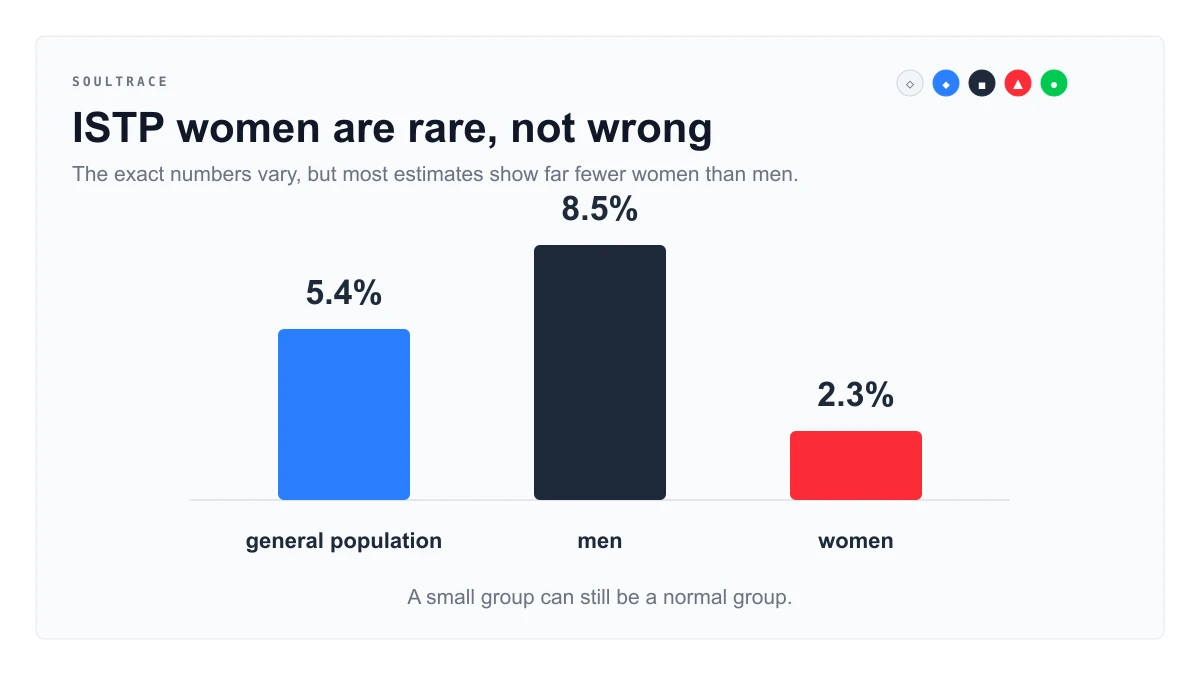
The ISTP personality type is already uncommon - roughly 5% of the general population. Among women it drops to about 2-3%. If you're one, you already know. You've probably spent half your life wondering why you don't click with the way other girls talk, argue, or hang out.
Being an ISTP woman usually means you're running on a different frequency than the women around you. You'd rather figure out how the washing machine broke than unpack last week's group-chat drama. Silence doesn't bug you. Performing warmth does. That mix makes you an outlier in most feminine-coded contexts, and it'll cost you some things while giving you others.
When faced with a complex decision, I prioritize a methodical approach over intuitive leaps.
Why they're so rare
The MBTI type distributions that CPP Inc. and other publishers have released over the years show a consistent pattern: Thinking types skew male, Feeling types skew female. ISTPs have one of the widest gender gaps in the whole model. Figures vary by dataset, but the usual ballpark is 9% of men and 2-3% of women. That's a three-to-four-to-one split.
Is it biology? Socialization? Both? People have been arguing about this since Isabel Briggs Myers published the original type tables, and nobody's settled it. Honestly, the mechanism matters less than the lived result: ISTP girls grow up feeling different, often early, often without a name for it.
The socialization piece is worth spelling out because it's where most of the pain comes from. Girls get pushed toward nurturing, emotional expression, social bonding, and relationship upkeep. Those expectations slam head-on into how ISTPs actually operate. ISTPs process inside their own heads, but girls are told to share feelings. They prefer solo activities, while girls get herded into social groups. Love shows up as doing stuff - fixing your bike, driving you to the airport - but girls are expected to say it out loud. And staying calm when things go sideways reads as cold when every other girl in the room is allowed to fall apart.
By age ten most ISTP girls have already collected the labels: too quiet, too cold, not nurturing enough. Your type doesn't change, but the self-doubt those labels plant can take years to dig out.
What an ISTP woman actually looks like
Take ISTP men - practical, mechanical, allergic to bullshit - and drop them into a female body raised under different expectations. That's roughly the picture. An ISTP woman wants to know how things work and fix what's broken. She'll pop the hood before she calls a mechanic. She's the engineer out-producing her colleagues in a male-dominated team, the welder, the surgeon, the EMT who stays weirdly calm when everyone else is screaming.
Independence isn't a stance she's taking. It's just how her OS is built. Telling her what to feel or want generates instant resistance - not because she's rebellious, but because figuring things out for herself is how she learns. She'd rather do than talk about doing.
The emotional reserve is the trait that gets most misread. ISTP women feel plenty. They don't perform it for the room. When something actually matters they handle it internally or show it through action. That works fine with people who read actions. It lands badly in contexts where women are expected to narrate their inner state on demand, which is most contexts. So she gets called cold, distant, unfeminine, sometimes sociopathic by people who've never bothered to learn how she actually operates.
Same story with her communication. She says what she means. No qualifiers, no hinting, no coded messages. From a man that reads as confident. From a woman it reads as harsh. She'll negotiate that double standard her whole life.
The challenges she actually faces
The femininity expectation is usually the biggest one. Traditional femininity leans heavily on appearance, emotional expressiveness, decoration over function, likability over competence. ISTP women rarely care about most of that, and when they do it's functional (good boots, not cute boots). Some conform on the surface to keep the peace. Some tap out entirely and eat the social cost. Neither choice is wrong. The question is which one you can actually sustain without grinding yourself down.
Relationships come loaded with assumptions about who does the emotional labor. Women are usually expected to track everyone's moods, keep the group chat alive, remember the birthdays, smooth over the arguments. An ISTP woman isn't failing at these because she doesn't care - she cares plenty about her partner. She just doesn't express it through that particular channel. A partner who reads "I fixed your laptop at 1 a.m." as love will feel deeply supported. A partner who needs a verbal "I love you" three times a day will feel neglected.
Work is its own maze. ISTP women in male-dominated fields get a weird paradox: they're temperamentally well-suited to the job but face gender-based skepticism anyway. Directness reads as aggressive. Reserve reads as cold. And independence gets filed under "doesn't play well with others." The exact traits that make ISTP men look promotable can quietly tank ISTP women in the same role. Recognizing this early saves a lot of wasted energy trying to figure out what you did wrong.
When faced with a complex decision, I prioritize a methodical approach over intuitive leaps.
Finding people is harder too. With 2-3% of women sharing your type, your odds of meeting someone who gets you in any given room are low. Most female social spaces run on a conversational style that feels tedious to you - a lot of processing, a lot of checking in, a lot of reassurance. That doesn't mean you don't want connection. You do. You want connection that doesn't require you to perform a version of femininity you don't feel.
The strengths
The upside is large, and most of it compounds.
ISTP women who lean into their natural abilities get genuinely good at things. Practical orientation plus focus plus stubborn persistence produces real competence - the kind that speaks for itself once the work is on the table. In any field that judges results over presentation, that's a massive edge. Your gender stops being a data point when your output is undeniable.
In a crisis you're built different. Everyone else freezes or spirals. You assess, you act, you fix what can be fixed. ERs, disaster response, startup-on-fire situations, kid bleeding on the kitchen floor - these are your natural environments. Organizations that know what they have in an ISTP woman put her exactly there.
The rarer strength is self-possession. An ISTP woman who's made peace with her own wiring stops chasing external approval. She doesn't perform. She doesn't shape-shift to be liked. That kind of quiet solidity is magnetic to anyone who's tired of social theater, and it filters out the people who'd drain you anyway. What shows up in its place is simpler: no manufactured drama, no games, no endless emotional post-mortems on every interaction. What you see is what you get.
In relationships
The thing that wrecks an ISTP woman's relationship fastest is a partner trying to renovate her - get her more expressive, more social, more traditionally feminine. She'll adapt on the surface for a while. Then she'll hit her limit, and the limit is not negotiable. What she actually needs is someone who respects her independence without reading it as rejection, who doesn't demand constant emotional narration, who speaks plainly, and who can sit in a room with her in silence without getting anxious.
What she gives back is substantial. Reliability. Calm when things break. Direct honest communication with no decoding required. Loyalty that doesn't cling. Problems she'll quietly solve before you've noticed them. She loves by doing. Partners who read that channel feel deeply held. Partners who need verbal affirmation as primary fuel will starve. For more on how ISTPs show up in love, see our guide on ISTPs in relationships.
Compatibility tends to go easier with partners who don't bring heavy gender scripts to the table. That usually means people who value competence over femininity, who like their own space, who are fine with emotional reserve, and who don't expect hints to be decoded telepathically. For type-by-type matching, see our ISTP compatibility guide.
If you're an ISTP woman reading this
You're not broken. If you've spent years quietly wondering what's wrong with you, stop. There's nothing wrong. Your brain runs differently from most women's brains, which isn't pathology - it's variation, and it's been there since you were seven.
The traits that make you feel like a weirdo - independence, emotional reserve, practical wiring, bluntness - are real strengths in the right context. The problem isn't you. The problem is environments that don't value what you actually bring. So stop trying to fix yourself and start picking better environments. Fields that reward competence over personality. Workplaces that measure output, not vibes. Communities built around shared activities instead of shared feelings. Partners who like you the way you are instead of the way they wish you were.
You don't need many friends, but you need a few. Aim for people who share your interests, talk straight, don't need hours of emotional processing, and respect your need to disappear for a weekend. One real friend beats ten who require constant upkeep.
When faced with a complex decision, I prioritize a methodical approach over intuitive leaps.
On the communication side, your directness is an asset - just learn when to modulate it. Adding "I think" or "in my experience" to a blunt statement isn't you going fake. It's you choosing your effectiveness over the satisfaction of being maximally unfiltered. Big difference.
Watch your energy too. You'll get asked to do emotional labor that doesn't come naturally - being the listener, managing other people's feelings, performing warmth on cue. You can do it. It just costs you more than it costs a Feeling type, and ignoring that cost is how ISTP women burn out. Set limits before the bill arrives.
Discover how ISTP traits map to SoulTrace's 5-color personality model, or compare the Operator and Maverick archetypes.
So what?
ISTP women are rare and that rarity has a price. Growing up feeling off, facing femininity expectations that don't fit, working inside systems that punish the exact traits that make you good at the job - none of it's fun.
But the same rarity is also the whole point. Practical competence, calm under pressure, self-possession, zero tolerance for drama - those are worth a lot in any room that knows how to recognize them. Your job isn't to reshape yourself. Your job is to find the rooms that know. ISTP women who do that end up building quiet, capable lives that feel like their own.
You're not broken. You're just rare. Rare isn't the same as wrong.
Want to map out how you actually tick? Take our comprehensive personality test to see your full psychological profile.
What Readers Usually Need Next
Queries around ISTP Women: Why Female ISTPs Are Rare usually mix curiosity with ranking pressure. That makes the topic easy to misread. Rarity, intelligence, and social reputation are not the same thing, and a type label should not be used as proof that someone is smarter, deeper, harder to love, or more valuable.
A better next step is to ask what the pattern changes in practice. Does it affect how someone learns, protects energy, reads social risk, or makes decisions under uncertainty? Those questions keep the page useful without turning type content into status content.
When the search intent is high-volume, a page also needs to say what not to do. Do not treat a ranking, percentage, or viral type description as a diagnosis. Do not use one test result to explain every conflict. Use it to generate better questions, then look for patterns across time.
Other Articles You Might Find Interesting
- Understanding the
ISTPpersonality type - Complete guide toISTPstrengths, cognitive functions, and growth ISTPcompatibility guide - Which types pair best with ISTPsISTPcareers - Best career paths for the Virtuoso personalityISTPvsINTP- How these similar types actually diverge
Stay in the loop
Get notified about new archetypes, features, and insights.