
By Francesco Zuppichini, Francesco Cicala
- 12 min Read
TL;DR:
INTJanger usually gets quiet before it gets loud. If anINTJstops arguing and starts watching, they may already be deciding what to do next. The silence is not always calm.
INTJs have a reputation for being cold and unemotional. People assume the Architect doesn't feel things deeply. They're wrong. INTJs feel anger as intensely as anyone, they just process and express it so differently that it's often unrecognizable.
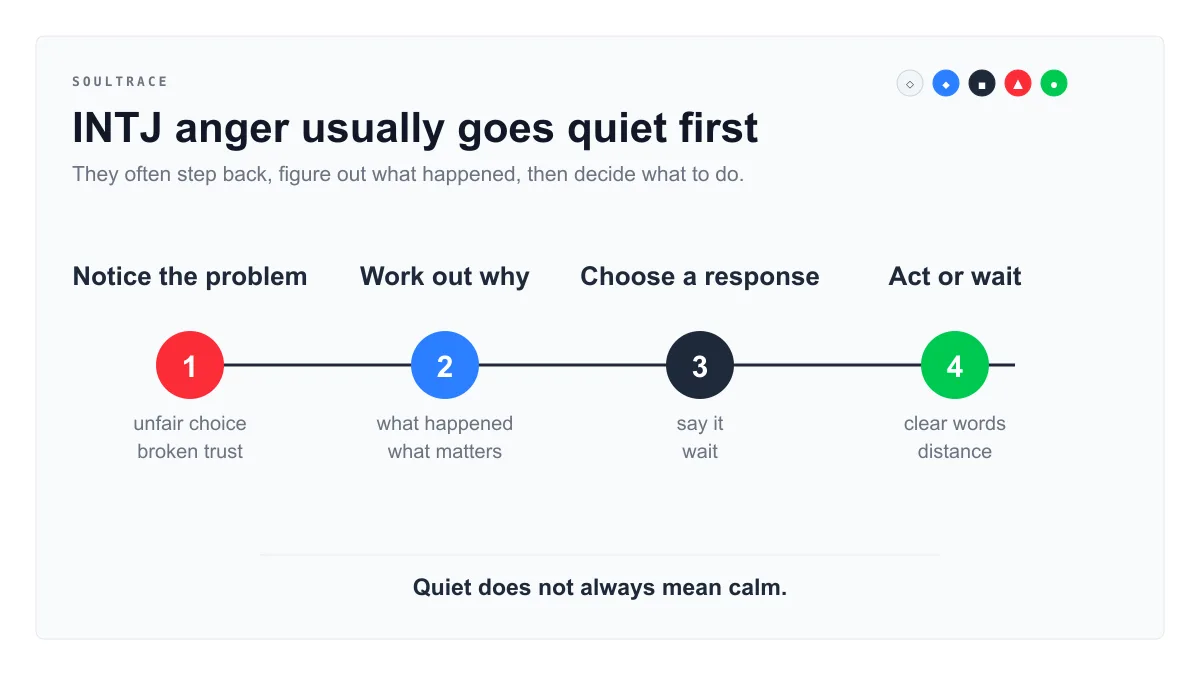
For INTJs, anger doesn't explode. It calculates. While other types might shout, slam doors, or say things they'll regret, the INTJ goes quiet. Their mind shifts from whatever they were doing to analyzing the threat, cataloging the offense, and if the transgression is serious enough, planning a response the offender won't see coming.
When faced with a complex decision, I prioritize a methodical approach over intuitive leaps.
That cold silence isn't absence of anger. It's anger with a strategy.
How INTJs Process Anger Internally
When an INTJ gets angry, their dominant Introverted Intuition (Ni) immediately starts modeling: What caused this? What does this mean? What are the implications? Their auxiliary Extraverted Thinking (Te) follows with tactical questions: What's the most effective response? What outcome do I want? What's the cost-benefit of different reactions?
This internal processing creates a delay between trigger and response that looks like calm. It's not calm. It's computation.
The internal experience typically involves:
- Rapid analysis of why this situation triggered anger
- Assessment of whether the cause was intentional or accidental
- Evaluation of the offender's likely reasoning
- Modeling of various response options and their consequences
- Selection of the most strategically appropriate action
This might take seconds or days depending on complexity. Either way, the INTJ's external presentation remains controlled while their internal experience may be anything but.
In the five-color personality system, this reflects the INTJ's strong Blue (analytical processing) and Black (strategic self-protection) traits working together to transform raw emotional energy into calculated response.
What Triggers INTJ Anger
Not everything that annoys INTJs makes them angry. They're good at dismissing minor irritations as not worth their energy. But certain triggers reliably activate their rage:
Incompetence That Affects Them
INTJs tolerate incompetence they can avoid. But when someone else's failure to perform creates problems they have to solve, clean up, or suffer consequences for, that triggers real anger.
The IT person who broke the system. The project manager who missed obvious risks. The colleague whose sloppy work means the INTJ has to work weekends. These aren't just annoyances; they're forced taxes on the INTJ's time and energy imposed by people who couldn't be bothered to do their jobs.
Intellectual Dishonesty
Deliberate logical fallacies, willful ignorance defended as opinion, or arguments made in bad faith enrage INTJs. They can respect someone who disagrees based on different values or information. They cannot respect someone who argues dishonestly or refuses to engage with evidence.
This includes:
- Moving goalposts when losing an argument
- Appealing to emotion when logic fails
- Dismissing expertise with "everyone's entitled to their opinion"
- Refusing to acknowledge when they've been proven wrong
Disrespect of Their Competence
INTJs build their identity around being capable and knowledgeable. Attack that core and watch what happens. Dismissing their expertise, undermining their authority, or treating them as less competent than they are doesn't just hurt. It activates defensive fury.
This is especially potent when the disrespect comes from someone the INTJ considers less competent. Being corrected by an expert is acceptable. Being corrected by an idiot is war.
Betrayal of Trust
INTJs don't trust easily. When someone they've trusted betrays that trust through lies, broken confidences, or deliberate harm, the anger isn't just about the specific action. It's about the violation of something rare they gave.
This often leads to the INTJ door slam, but before the door closes, there's anger that may never be expressed but absolutely exists.
Attacks on People They Protect
INTJs might seem detached, but they're fiercely protective of their inner circle. Hurt someone they love and you'll discover that INTJ anger on behalf of others burns hotter than anger on their own behalf.
They might tolerate disrespect toward themselves. They will not tolerate disrespect toward their people.
Forced Irrationality
Being compelled to participate in systems or decisions that violate logic infuriates INTJs. Corporate policies that make no sense. Social expectations that serve no purpose. Rules that exist because "that's how we've always done it."
INTJs can compromise. They can follow rules they disagree with when the cost-benefit makes sense. But being forced into irrational behavior with no recourse triggers anger that may simmer for years.
Violation of Autonomy
INTJs value control over their own lives above almost everything. Attempts to control, manipulate, or constrain their choices, especially by people who have no authority to do so, provoke immediate defensive anger.
This includes well-meaning interference. The friend who shares their secret "to help." The parent who makes decisions for their adult child. The manager who micromanages. Intent doesn't matter. The violation does.
INTJ Anger Expression Styles
Their anger rarely looks like what people expect. Here's how it actually manifests:
The Freeze-Out
The most common INTJ anger response is withdrawal. They stop engaging. Conversations become monosyllabic. They're present but absent. They haven't forgiven; they've categorized you as not worth the energy of conflict.
This isn't passive aggression. It's calculated resource allocation. Fighting takes effort. Withdrawal preserves energy while still protecting the INTJ from further harm.
Surgical Verbal Strikes
When INTJs do express anger verbally, it's not random rage. It's precision targeting. They've identified your insecurities, your weak points, your contradictions. If they choose to speak, they'll say exactly what will hurt most in exactly the tone that will make it land.
This isn't loss of control. It's controlled demolition. They could say more, hit harder, go further. They're choosing their words carefully even while angry.
Cold Analysis Delivered as Fact
When faced with a complex decision, I prioritize a methodical approach over intuitive leaps.
Sometimes INTJ anger comes out as devastatingly accurate criticism delivered without emotional color. They won't tell you they're angry. They'll simply explain, in detail, exactly how and why you failed, what it says about you, and what consequences will follow.
This can be more devastating than shouting because it sounds rational. It sounds like objective assessment. It might even be accurate. But it's also anger expressed as judgment.
The Long Game
For serious offenses, INTJ anger may go underground entirely, only to resurface as strategic action months or years later. They remember. They plan. When opportunity arises to correct the situation to their advantage, they act.
This isn't necessarily revenge. It might be positioning to avoid future harm, restructuring a relationship on better terms, or simply ensuring the offender can't repeat the offense. But it's motivated by anger that never dissipated. It just got patient.
Rare Explosive Episodes
INTJs can explode, though it's uncommon. When they do, it usually means accumulated pressure finally exceeded containment capacity. These episodes are often followed by embarrassment, not because the anger wasn't justified, but because loss of control feels like failure.
If you've witnessed an INTJ explosion, understand that reaching that point required sustained, serious provocation. They didn't lose control easily.
Why INTJs Struggle with Anger
Despite sophisticated processing, INTJs often have an uncomfortable relationship with their own anger:
They're supposed to be "rational": INTJs identify with logic. Anger feels irrational. This creates internal conflict because they're experiencing an emotion they've categorized as inferior, which generates shame or denial on top of the anger itself.
Expression feels inefficient: Yelling, arguing, and venting all cost energy without guaranteed return. INTJs often conclude that expressing anger accomplishes nothing except depleting their resources. So they suppress it, which doesn't make it go away.
They analyze instead of feeling: When anger arises, INTJs immediately intellectualize it. They understand why they're angry, model it as a phenomenon, examine it from multiple angles, but may never actually feel it fully. The anger gets trapped in mental loops rather than experienced and released.
Vulnerability is dangerous: Expressing anger reveals you care. It shows what hurts you, what reaches you, what matters. INTJs guard that information carefully. Showing anger feels like giving enemies a map to their weaknesses.
INTJ Anger vs Other Types
Compared with other types, the pattern has distinctive qualities:
| Aspect | INTJ Anger |
Typical Anger |
|---|---|---|
| Onset | Delayed while processing | Often immediate |
| Expression | Controlled, strategic | Reactive, emotional |
| Duration | Can persist indefinitely | Usually time-limited |
| Recovery | Requires cognitive resolution | Often resolves with emotional expression |
| Danger | Long-term consequences | Immediate conflict |
The INTJ who says "I'm not angry" while quietly planning your professional destruction isn't lying about their subjective experience. They've converted anger into something that no longer registers as anger to them. It's still anger. It's just been processed into a different form.
How to Handle an Angry INTJ
If you've angered an INTJ and want to repair things:
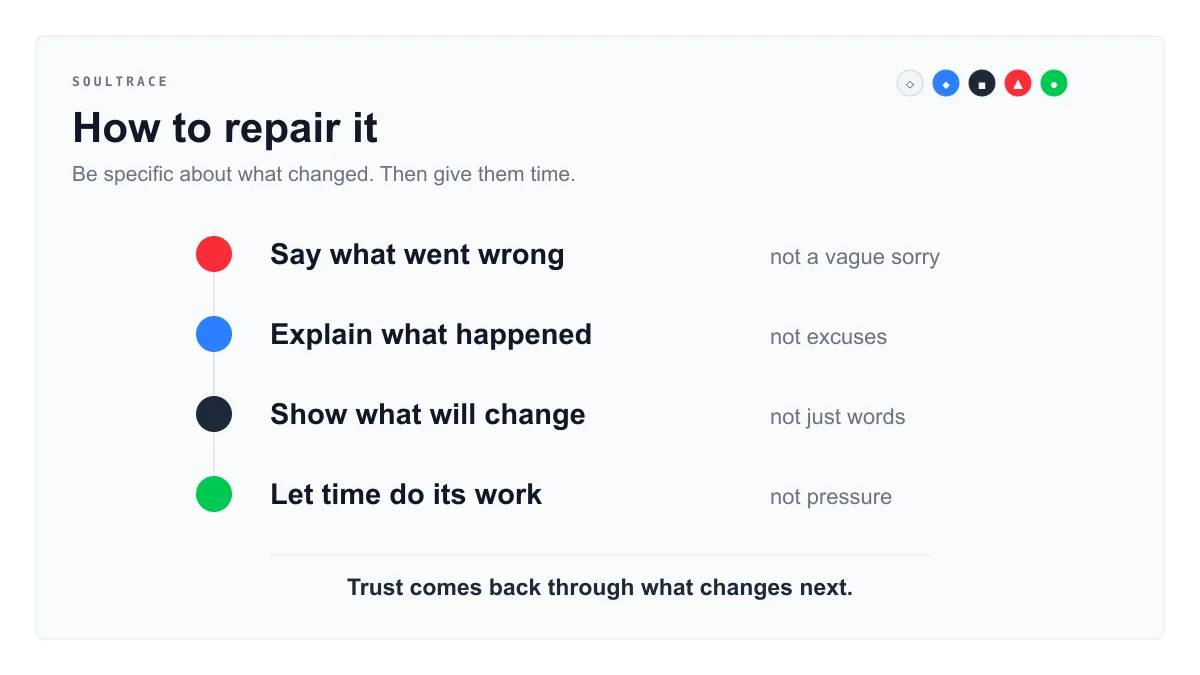
Don't demand immediate discussion: They need processing time. Pushing for instant resolution while they're still computing will make things worse. Give them space to think.
Acknowledge the specific failure: Generic apologies mean nothing. You need to demonstrate you understand exactly what you did wrong and why it mattered. Vague "I'm sorry you feel that way" statements confirm you don't get it.
Explain your reasoning: INTJs want to understand causation. Why did you do what you did? What were you thinking? This isn't about excuses. It's about providing data that helps them make sense of the situation.
Show changed behavior: Words are cheap. INTJs track patterns over time. If you've apologized, they're watching to see whether your behavior actually changes. Follow-through matters more than the apology itself.
When faced with a complex decision, I prioritize a methodical approach over intuitive leaps.
Accept it might be permanent: Some INTJ anger doesn't resolve. If you've crossed certain lines like betrayal, sustained disrespect, or fundamental value violation, the relationship may be irrecoverable. The door slam exists for a reason.
How INTJs Can Manage Their Anger Better
Acknowledge It Exists
Stop pretending you're above anger. You're not. The emotion is there whether you label it "frustration," "irritation," or "logical disagreement." Call it what it is and let yourself actually feel it sometimes.
Express Before It Builds
Waiting until you've built an airtight case before addressing issues means the other person had no chance to course-correct. Earlier, less polished communication prevents larger explosions later.
Physical Release
Your body is holding this anger. Exercise, physical activity, even just walking can help discharge the physiological component of anger that gets trapped when you only process mentally.
Challenge Perfectionist Expectations
Some INTJ anger stems from expecting a level of competence, logic, or behavior that humans simply can't consistently deliver. Adjusting expectations doesn't mean accepting mediocrity. It means being realistic about what you can reasonably demand from flawed beings, including yourself.
Consider the Full Picture
When someone triggers your anger, you're probably right about what they did wrong. But you might be wrong about why they did it, what they intended, or what they're capable of doing better. The same analytical skills that fuel your anger can be turned toward understanding context that might change your assessment.
Discover how INTJ traits map to SoulTrace's 5-color personality model, or Compare the Strategist and Operator archetypes.
Conclusion
The anger is real, intense, and potentially devastating, but rarely looks the way anger "should" look. The quiet withdrawal, the precisely targeted criticism, the long-term repositioning are all expressions of the same underlying emotion, filtered through a cognitive system that prizes strategy over expression.
Understanding this helps both INTJs and those around them. INTJs can learn to recognize and express their anger more effectively rather than suppressing or weaponizing it. Others can learn to read the signals that anger is present even when it's not being performed conventionally.
The INTJ who understands their own anger patterns gains significant advantage. They can use anger as information about boundary violations without being controlled by it. They can express it in measured ways that actually resolve problems rather than just signaling displeasure. They can harness its energy for constructive purposes rather than letting it curdle into resentment.
Anger isn't the opposite of rationality. It's a data source like any other. The rational approach is to understand it, not deny it.
Want to understand how your personality type handles emotions and conflict? Take our adaptive personality test to discover your patterns for processing and expressing difficult feelings.
Other Articles You Might Find Interesting
- Complete guide to the
INTJpersonality type - Full psychological profile of the Architect - Signs of an unhealthy
INTJ- WhenINTJpatterns become dysfunctional - The
INTJdoor slam explained - What happens whenINTJanger leads to permanent disconnection INTJghosting behavior - Why INTJs withdraw without explanation
Stay in the loop
Get notified about new archetypes, features, and insights.