
By Francesco Zuppichini, Francesco Cicala
- 12 min Read
TL;DR: "Use IDRlabs as a question generator, not a verdict." Its best tests can give useful self-reflection, but the site mixes serious constructs with novelty quizzes, so judge each result by the theory behind it.
IDRlabs is worth using, but only with a filter. Treat it as a huge library of psychology quizzes, not as a place to get a diagnosis or a fixed identity. The strongest pages can give you language for a pattern you already notice. The weakest pages are entertainment with academic styling.
That distinction matters because IDRlabs ranks for a lot of test searches and covers a strange range: Big Five, Dark Triad, attachment style, cognitive functions, political compass tests, character tests, pathology-style quizzes, and niche constructs most people only discover after falling into the site. The mistake is treating every result page as if it carries the same evidence.
When faced with a complex decision, I prioritize a methodical approach over intuitive leaps.
The sensible way to use IDRlabs is not "trust everything" or "ignore everything." Trust the construct, not the polish. A Big Five or attachment-style result deserves more attention than a fictional-character match. An MBTI cognitive-functions result can be fun if you already like type theory, but it should not carry the same weight as a better researched trait model.
Quick Take
Use IDRlabs for exploration, not proof. Do not use it for clinical decisions, hiring decisions, relationship ultimatums, or proof that you are one fixed type.
The stronger pages usually do three things: they name the theory behind the test, they explain the limits, and they avoid turning a score into a life sentence. The weaker pages still produce a neat result, but the result is only as good as the construct underneath.
The clean takeaway:
| IDRlabs test type | How seriously to take it |
|---|---|
| Big Five, attachment, Dark Triad style traits | Useful self-reflection, still not professional assessment |
| MBTI, cognitive functions, Enneagram | Fine for type-language exploration, weak as science |
| IQ, diagnostic, disorder-adjacent quizzes | Treat as rough prompts only |
| Fictional character, villain, aesthetic, fandom tests | Entertainment |
That ranking is harsher than the site presentation, but it is more useful.
What IDRlabs Actually Offers
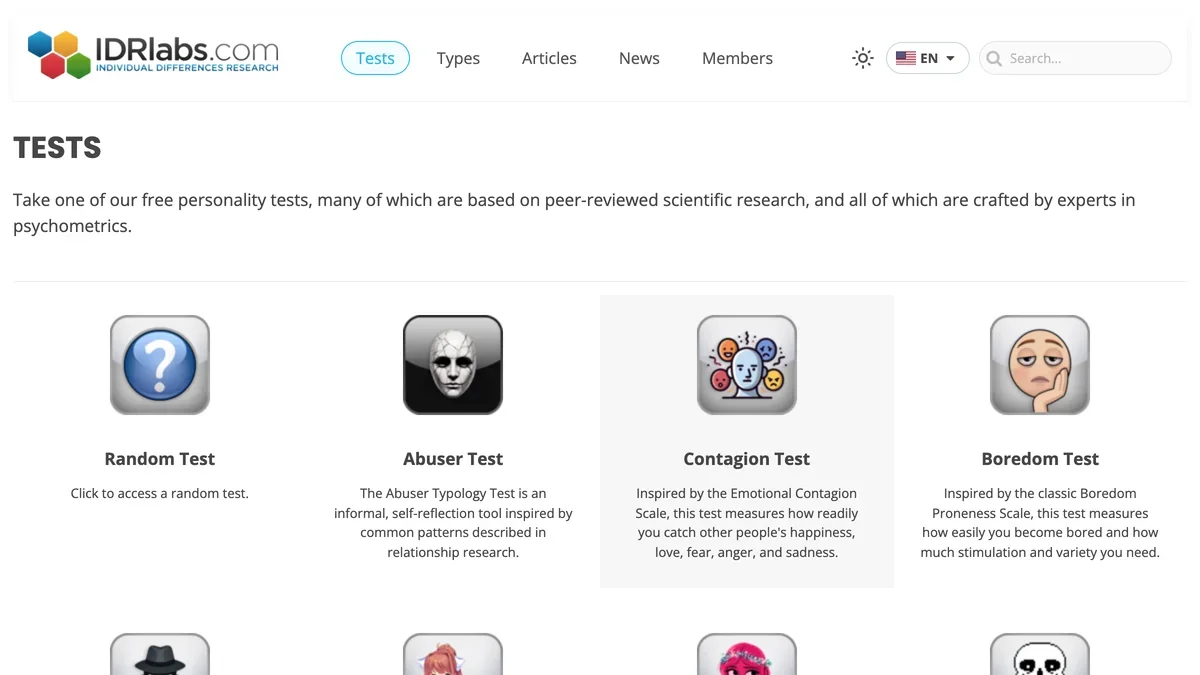
The site is not a single personality test. It is a catalog. IDRlabs' own homepage currently presents the platform as having published more than a thousand tests, many of them framed around peer-reviewed research or one-of-a-kind constructs.
That breadth is the appeal. You can move from a Dark Triad test to a Big Five quiz to a political compass test without creating an account. The friction is low, the result pages are quick, and the site gives enough explanation to feel more serious than a random social-media quiz.
Breadth is the appeal and the trap. A platform that hosts hundreds of tests cannot make every result equally meaningful. Some pages are anchored in established psychology. Others borrow the style of psychology without the same measurement strength.
The site is best understood as a search engine for psychological self-reflection. It gives you prompts. You still have to judge the prompt.
The Accuracy Problem
People ask whether IDRlabs is accurate, but that question is too broad. Accuracy is not a site-wide property. It belongs to the specific test.
A Big Five test can be judged against a large research tradition. A dark-traits test can at least point to named constructs with a research history. An attachment-style test has a recognizable theory behind it, even if a quick online version is still limited.
An MBTI cognitive-functions test is different. It can be internally consistent and still rest on a framework that psychologists do not treat the same way they treat Big Five traits. The result may be useful language, but "accurate" becomes slippery because the thing being measured is already disputed.
Fandom and character tests are different again. They are not trying to measure a durable psychological trait. They are sorting your answers into a cultural category. That can be fun. It is not evidence about your personality.
"The result is only as strong as the construct underneath it."
So the better question is not "Is IDRlabs accurate?" It is "What kind of claim is this specific test making?"
Tests I Would Treat As More Useful
The most useful IDRlabs tests tend to be the ones connected to a recognizable psychological construct and written with clear limits.
Big Five style tests are the safest starting point. The Big Five model is not perfect, but it is far better supported than most online typing systems. If an IDRlabs Big Five result says you score high on openness or low on conscientiousness, that can be a useful reflection point.
Attachment style tests can also be useful, especially for noticing relationship patterns. A quick result cannot explain your whole relational history, but anxious, avoidant, secure, and fearful-avoidant language can help you name repeated reactions.
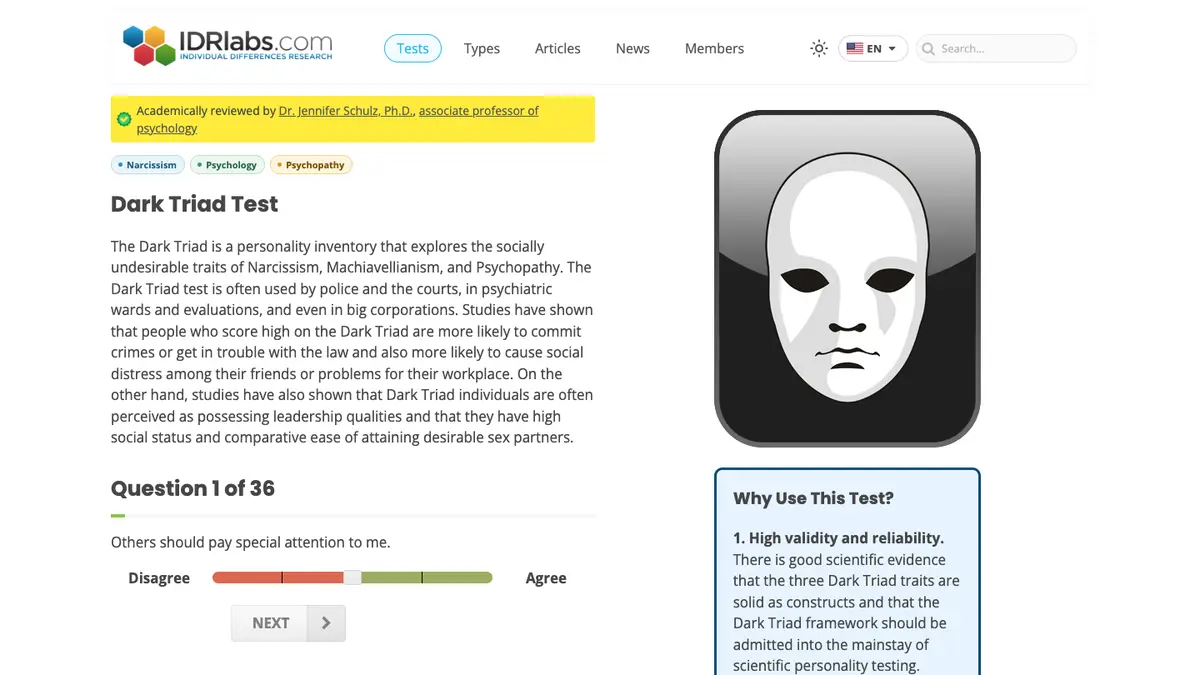
Dark Triad and difficult-person tests can be useful when handled carefully. They can make people think about manipulation, callousness, grandiosity, dominance, and suspicion. The risk is panic. A high score does not make someone a monster. A low score does not make someone harmless.
Personality Style Test style pages can be interesting because they push beyond the usual internet type labels. The safer read is "this page gave me language to inspect a pattern," not "this page identified my true condition."
For a broader map of test quality, read Personality Test Accuracy and Personality Tests Backed by Science.
Tests I Would Treat With More Caution
Some IDRlabs categories should be handled lightly.
IQ and intelligence tests are the obvious one. Real cognitive testing depends on standardized conditions, appropriate norms, and trained interpretation. A free web quiz can be interesting, but it should not become a verdict about your intelligence.
When faced with a complex decision, I prioritize a methodical approach over intuitive leaps.
Clinical and disorder-adjacent tests need caution too. A page may help you notice symptoms or traits worth discussing, but it cannot diagnose depression, ADHD, autism, personality disorders, or anything similar. If a result alarms you, use it as a reason to talk to a qualified professional, not as a self-diagnosis.
MBTI cognitive-functions tests are useful only if you already understand their limits. IDRlabs has several type-theory tests, and they can be fun for comparing labels. The trouble is that different function tests often disagree because the framework is hard to operationalize. If you are exploring MBTI, compare IDRlabs with a dedicated option like the Sakinorva MBTI test, then keep both results flexible.
Hyper-specific novelty tests are mostly entertainment. That does not make them worthless. It just means their value is the conversation they start, not the psychological authority they carry.
Where The Site Feels Strong
IDRlabs has a few real strengths.
The first is access. You can take tests without signing up, paying, or sitting through a complicated onboarding flow. That matters because many personality sites hide the result until the end or force an email gate after the user has already invested time.
The second is range. IDRlabs covers far more than the usual MBTI and Enneagram loop. That helps readers discover constructs they would not otherwise search for.
The third is transparency. Many tests explain the theory they are based on and include some kind of limitation language. That gives readers a chance to judge the foundation instead of accepting a score on vibe alone.
The fourth is speed. A fast test is not automatically a good test, but it can lower the barrier to self-reflection. For a user who only wants a quick prompt, IDRlabs often does enough.
Where The Site Gets Messy
The weakness is quality control.
A reader can move from a test based on a serious construct to a novelty page without a clear warning that the evidence level changed. The interface makes serious and silly tests feel more equal than they are. The psychological weight is not similar.
Another problem is result inflation. When a site gives you hundreds of tests, it becomes easy to keep testing instead of thinking. The next score feels like progress, but after a point it is just personality snacking.
Some result pages also stop too early. They tell you what you scored, but not what to do with that information. A good personality result should explain the tradeoff: what the pattern helps with, where it creates friction, and what a reader can actually observe in daily life.
The last weakness is diagnostic gravity. Even with disclaimers, disorder-adjacent tests can make people treat a score as identity. That is risky. A web test can suggest a question. It cannot settle it.
How IDRlabs Compares With Other Test Sites
Against 16Personalities, IDRlabs is broader and less polished. 16Personalities gives one clean branded experience. IDRlabs gives a shelf full of tests with uneven depth.
Truity is more packaged. Truity usually gives smoother result explanations and a more commercial product flow. IDRlabs feels more like a large public test archive.
PersonalityMax is broader but more contained. PersonalityMax bundles several familiar frameworks into one report, while IDRlabs lets you wander through a much larger test library.
Sakinorva is more specialized. Sakinorva is known mostly in MBTI and cognitive-function circles. IDRlabs is more useful if you want to browse many constructs, not just type theory.
SoulTrace solves a different problem. IDRlabs gives you many separate tests. SoulTrace gives one adaptive assessment built around a five-color model and archetype result. That means IDRlabs is better for browsing, while SoulTrace is better if you want one coherent personality read.
When faced with a complex decision, I prioritize a methodical approach over intuitive leaps.
How To Use IDRlabs Without Fooling Yourself
Before you believe a score, ask what the test is based on. If the page references a well-known trait model, give it more weight. If it references a fictional universe or an invented category, treat it as entertainment.
Look for consistency across results. One score is weak evidence. A pattern across several serious tests is more useful.
Pay attention to your reaction. If a result annoys you, ask whether it is inaccurate or whether it hit something uncomfortable. If a result flatters you, ask whether it says anything specific enough to be useful.
Do not outsource judgment. A score can point to a pattern, but it cannot understand your context. Work stress, mood, age, relationship state, and recent events can all shape how you answer.
Avoid taking ten tests in one sitting and treating the stack as truth. More results can make you feel certain without making you more accurate.
Better Alternatives When You Want One Serious Result
For evidence-backed trait language, start with a solid Big Five or HEXACO-style test. Read Big Five Personality Test or HEXACO Personality Test for that path.
For type language, use MBTI-style tools for vocabulary, not proof. Read MBTI Test and Is MBTI Pseudoscience? before you treat a four-letter code as destiny.
For one adaptive result instead of a long afternoon of separate quizzes, take the SoulTrace personality test. It is built to return a distribution across psychological drives, not a single hard label.
Bottom Line
IDRlabs is useful when it starts a better question. It is risky when it ends the conversation. Its best tests are useful reflection tools. Its weakest tests are entertainment. The site becomes misleading only when every result is treated as equally scientific.
Use IDRlabs to collect questions about yourself. Use better frameworks, repeated patterns, and real-life evidence to decide which answers deserve trust.
What Readers Usually Need Next
People searching for IDRlabs Tests: Accuracy, Best Picks, and Limits often need a quick answer first: what the test is good at, what it misses, and whether it is worth using before they invest time in a result. The safest reading is to treat the tool as a lens, then check whether the explanation matches behavior you can actually observe.
If a result gives you a type but not a reason, compare it with a motivation-based model. Ask what the result predicts about decisions, conflict, stress, and connection. A test earns trust when it helps you make those predictions without flattening your personality into a mascot.
When the search intent is high-volume, a page also needs to say what not to do. Do not treat a ranking, percentage, or viral type description as a diagnosis. Do not use one test result to explain every conflict. Use it to generate better questions, then look for patterns across time.
Other Articles You Might Find Interesting
- Difficult Person Test - How to read one of IDRlabs' most popular test categories
- Dark Triad Test - What high dark-trait scores do and do not mean
- Popular Personality Tests - How major test platforms compare
- Personality Test Accuracy - What makes a personality test reliable enough to use
Stay in the loop
Get notified about new archetypes, features, and insights.